The Case for Good Code with Coding Agents
2026-04-02
Software development is changing. In the past couple of months we've heard stories ranging from Claude Code writing a somewhat functional C compiler to companies reporting that >90% of their code being written by AI. At Greptile we found that in 2025, the median lines of code contributed per developer grew from 4,450 to 7,839, while individual file changes became 20% larger and "denser." 1 More code is being generated faster than before and there is no sign of things slowing down.
While this is all very exciting, like many other developers I am quite alarmed by this progression. The worry is of AI slop-ware, subpar software generated by AI that is being shipped to end consumers. Recent analysis of vendor status pages shows that outages have steadily increased since 2022. 2 Amazon is trying to crack down on vibe-coding related incidents. 3 Many engineers don't even like the code that is being generated. Andrej Karpathy describes: "agents bloat abstractions, have poor code aesthetics, are very prone to copy pasting code blocks and it's a mess, but at this point I stopped fighting it too hard and just moved on." 4 Any developer who has spent time with these agents can empathize with the sentiment.
So what are we to do? One thing we can be sure of is that decelerating software creation is not the answer. Software generates tremendous value compared to no software; the previous bottleneck, the cost of development, going to zero is a net good for the world.
Yet the fear of slop-ware is real. It may be that all software is built just well enough that nobody stops to ask if it could have been built better. Companies will continue to invest more tokens, the model labs will continue to grow, most users will get the software they want, and a select few developers will act as the directly responsible individual. In this world there is no mention or incentive for code quality and thus it seems inconsequential to the development process.
What I want to argue for, though, is that there is hope. Good code – as we will define it – will continue to exist into the future not out of some dogmatic obsession with the aesthetics of software 5, but by the same invisible hand that is driving the creation of such slop in the first place. To understand this, we define what good code is.
John Ousterhout describes it best in his A Philosophy of Software Design when he argues that writing good code is the process of reducing the complexity in a system. Complexity, he defines, is "anything related to the structure of a software system that makes it hard to understand and modify the system." 6 The broadest attributes of good code are:
- It is simple and easy to understand.
- It is easy to modify as a result.
Bad code is simply the opposite of this: it requires a lot of mental bandwidth to understand and it is full of shared dependencies and footguns. And as a result it is nearly impossible to modify for the future.
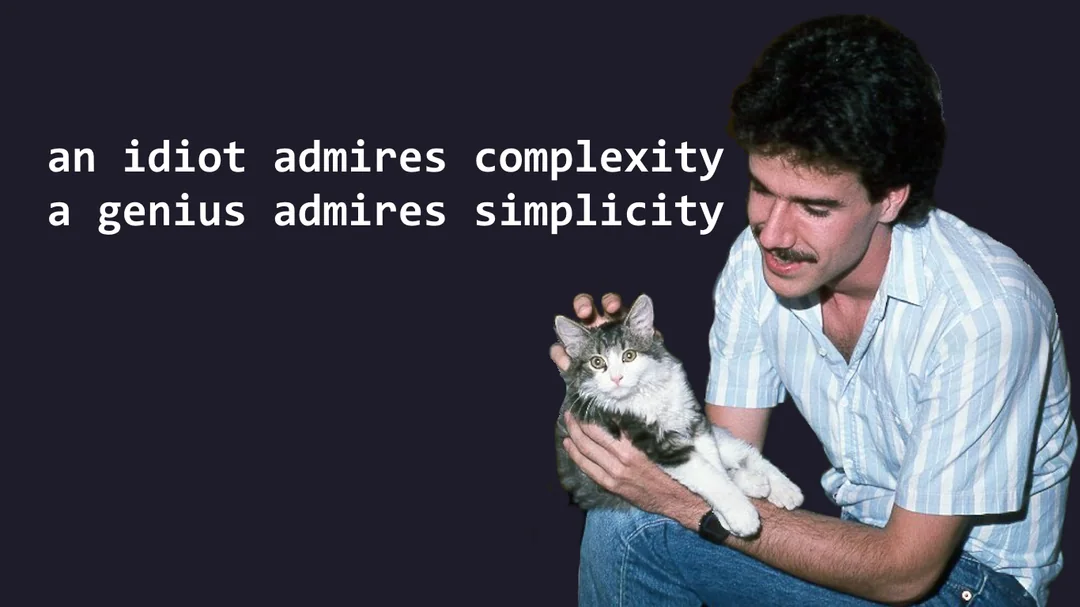
This principle applies the same way for AI agents. Coding agents will write good code because it is economically advantageous to do so. Per our definition, good code is easy to understand and modify. This means it requires less context to reason about a relevant piece of code and fewer lines of code to achieve some change. It is more token efficient to write and maintain software with good code. As long as software needs to be created and evolved over time, the incentives will be in good code's favor.
Today we are still climbing the existing benchmarks and defining what the correct benchmark looks like in the first place. Most companies are barely keeping up with the ever-changing best practices in agent-powered software development. However, once these benchmarks are established and saturated, and software production is mostly automated, competitive pressure will incentivize agents to write code that requires less context to reason about and fewer edits to achieve some outcome. Complex software will require more tokens and compute to create and maintain, and as codebases grow this cost grows exponentially. We will have good code as the markets will demand it.
Good code is good because it is practical. The principles of good code are invariant to the author or system that maintains or generates it. Therefore there is hope for those who care: good code has reason to exist in a future where all of software is automated.
Footnotes
-
State of AI Coding 2025, Greptile. ↩
-
Analysis of vendor status pages, r/sysadmin. ↩
-
Amazon targets vibe-coding incidents, Financial Times. ↩
-
There is a deeper truth to this: "Beauty is truth and truth is beauty." — John Keats. ↩
-
A Philosophy of Software Design, John Ousterhout. ↩